The Soft Power Home: What Your Space Says About You Before You Say a Word
This post is about intentional home decor — specifically, what it means to design a space that reflects your standards, your rhythm, and the woman you’re becoming. Not for the algorithm. For you.
You know the feeling of walking into a soft power home.
You walk into a room, and your shoulders drop. You exhale — not the shallow kind, the real kind. You breathe deep, and you smile without deciding to.
Nothing dramatic happened. Nobody said anything. The room just felt like you.
Now think about the opposite. The room that didn’t. The space you lived in but never quite inhabited. Maybe it was beige because beige was safe. Maybe it faced the wrong direction, and the light never came. Maybe it was full of things that looked fine together but said nothing about who you actually were.
That room had a voice too.
It just wasn’t yours.
Here’s what most home content won’t tell you: your space is speaking before you open your mouth. It’s communicating your standards, your rhythm, your relationship with yourself — to every person who walks in, and more importantly, to you, every single day. The question isn’t whether your home is saying something.
The question is whether you like what it’s saying.
That’s what the soft power home is about.
What “Soft Power” Actually Means in a Home
Soft power isn’t an aesthetic.
It’s not a color palette or a furniture style or a price point. It’s not the trending boucle chair or the perfectly neutral living room that photographs well. Those things can be beautiful. They’re not soft power.
Here’s the difference:
A pretty room says: Doesn’t this look nice?
A soft power room says: This space moves the way I move.
Pretty is copied. Soft power is curated. Pretty is Instagram-ready. Soft power manages light temperature, sound absorption, texture, and visual noise in ways that literally lower your cortisol and steady your nervous system. Pretty fills space. Soft power claims it.
The thing that tips a room from aesthetic into actual power is intention. Specifically: restraint. Fewer pieces. Better materials. Stronger silhouettes. Breathing room. A soft power room knows what it is and what it isn’t — and it doesn’t apologize for either.
Sound familiar?
That’s because a soft power home is just a woman’s interior life made visible. The same qualities that make a woman powerful — her clarity, her standards, her refusal to perform for anyone who isn’t worth it — those qualities show up in her space too. When they’re aligned, walking into the room feels like exhaling.
When they’re not, you feel it immediately. Even if you can’t name it.
What Your Space Is Actually Saying Right Now
Before we talk about what a soft power home looks like, let’s talk about what a room says when a woman hasn’t claimed it yet.
Clutter says: I haven’t decided what matters. Default decor says: I chose what was easiest. Beige everything says: I didn’t want to commit. Too many small objects says: I’m filling space instead of living in it. Furniture pushed against every wall says: I’m not sure I deserve to take up room.
None of this is a judgment. It’s a read. And most of us — especially women who have spent years being practical, responsible, competent, and useful to everyone around us — have rooms that reflect the version of ourselves we were when we were just trying to hold everything together.
The soft power home reflects the version of you that’s done just holding it together.
She has standards. She has taste she’s stopped apologizing for. She wants beauty — not as indulgence, but as necessity. Because she understands, finally, that the environment she lives in shapes how she thinks, how she rests, how she creates, and how she shows up everywhere else.
She’s done negotiating with herself about whether she deserves it.
The Four Things a Soft Power Home Always Communicates
1. Intentionality
Every object in a soft power home was chosen. Not grabbed, not defaulted to, not kept because it was already there — chosen. This doesn’t mean expensive. It means deliberate.
When you walk into a room where everything has been chosen with intention, you feel it before you understand it. The brain relaxes. There’s no visual noise competing for your attention. Everything belongs.
Intentionality is the foundation. Without it, the most beautiful objects in the world just look like a collection.
2. Standards
A soft power home has a point of view — and it holds that point of view even when trends push in a different direction.
Standards mean knowing what’s yours and what isn’t. It means resisting the urge to add something just because it’s on sale, just because everyone has it, just because it looked good on someone else’s shelf. It means editing as often as you add.
A room with standards feels settled. Confident without being rigid. It knows what it is.
3. Ease
This is the one people miss.
Soft power rooms are not high-maintenance. They don’t require constant adjustment, constant styling, constant effort to look right. A room that only looks good when it’s been staged isn’t a soft power home — it’s a performance.
A soft power home looks like itself on a Tuesday morning when nothing has been touched. The ease is built in through scale, proportion, and the deliberate absence of things that need constant attention.
Ease is a design choice. It’s also a life philosophy.
4. Identity
The last thing a soft power home communicates is the most important: who lives here.
Not in a monogrammed-everything way. In a this-couldn’t-belong-to-anyone-else way. The specific books on the shelf. The art that means something. The object brought back from somewhere. The color chosen because it makes her feel a particular way, not because it photographs well.
Identity in a home is the difference between a space that looks decorated and a space that feels inhabited. One has been styled. The other has been lived.
The Anchored Chair: That Home Girl’s Signature
Every soft power home has one.
The corner that anchors everything. The place that tells the truth about who lives there before a single word is spoken.
Mine is a chair.
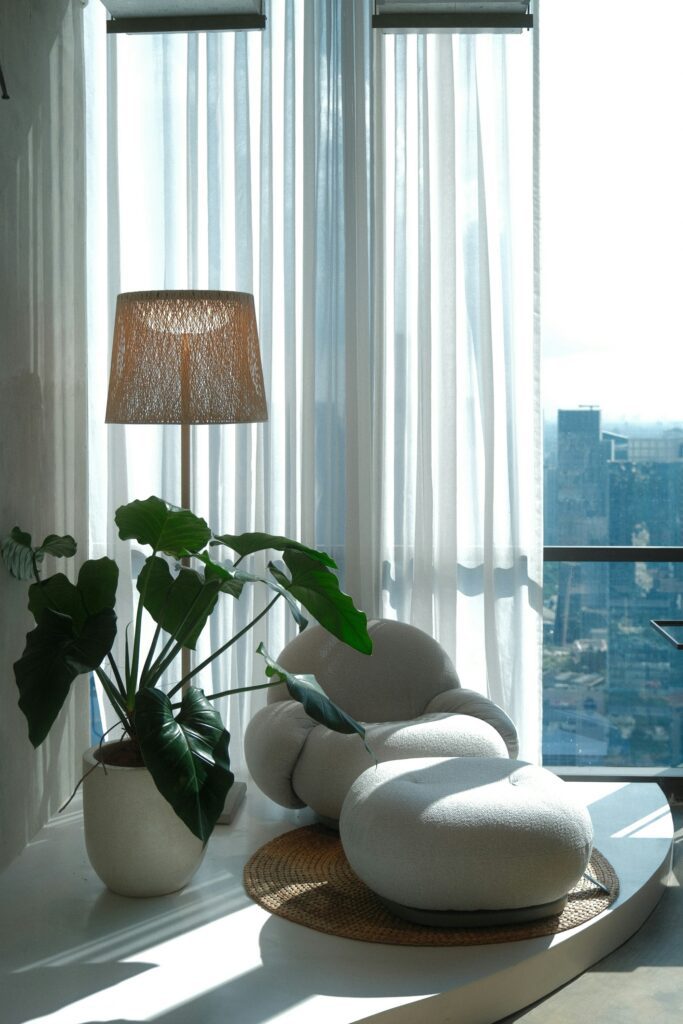
Not just any chair — a slightly oversized lounge chair with real weight to it, placed exactly where the light hits correctly. Paired with a small sculptural side table. A warm lamp at eye level — never overhead, never harsh. A substantial throw in cashmere or wool, draped without being arranged. One real book, the one actually being read, not displayed.
The lamp is at eye level. The materials are matte, never shiny. The scale is generous. And there is negative space around it — intentional breathing room that the rest of the room respects.
That corner breathes.
It’s not the most expensive thing in the room. It might not even be the most beautiful. But it’s the most true. It says: a woman lives here who has given herself permission to rest, to read, to exist in her own space without justifying it to anyone.
That’s what I call The Anchored Chair. Not a specific piece of furniture — a concept. The corner, the moment, the combination of objects that says this is mine in the quietest, most powerful way possible.
Every soft power home has a version of it. Your job is to find yours.
How to Start: Three Shifts That Change Everything
You don’t need a renovation. You don’t need a new budget. You need three decisions.
First: Fix the light.
Harsh overhead lighting is the fastest way to make any room feel institutional rather than intentional. Layer your lighting instead — a floor lamp, a table lamp at eye level, candlelight if you want it. Warm bulbs only. The difference between cold light and warm light in a room is the difference between a waiting room and a home.
Start here. Always start here. Good lighting makes everything else look better and costs less than almost any other upgrade you could make.
[Internal link: The THG Lighting Blueprint: How to Light Your Home Like a Grown Woman]
Second: Remove before you add.
Most rooms don’t need more. They need less. Identify the three objects in your space that are there by default — because they were already there, because someone gave them to you, because you haven’t decided what to do with them yet. Remove them for two weeks. Live in the space without them.
You’ll either miss them and return them with intention, or you’ll realize the room breathes better without them. Either outcome is the right one.
Third: Choose one corner and make it true.
Don’t try to transform the whole room. Find one corner — any corner — and make it say something honest about you. A chair you actually sit in. A lamp that gives the right light. One object that means something. Negative space around it.
That corner becomes your anchor. The room builds outward from there.
How to Build the Ultimate Capsule Kitchen on a Budget
The Capsule Home™: 5 Essential Decor Pieces for a Chic, Timeless Space
The That Home Girl Standard
Here’s what I know about the woman reading this:
She has good taste. She’s always had it. She just hasn’t always trusted it — or given herself permission to act on it without explaining herself first.
She’s done shrinking her taste to make it easier for other people to digest. Done choosing beige because it’s safe. Done explaining why she needs a reading chair no one else uses, or a lamp that’s just for the light it throws, or a throw pillow in a color that makes her feel something.
She has stopped apologizing for wanting beauty.
And she understands — maybe for the first time, maybe for the hundredth — that her home is not separate from her life. It’s not a backdrop. It’s not a project for someday when everything else is figured out. It’s where she rests and cries and reads and works and celebrates and ends her day.
It should feel like her.
Not a performance of her. Not an aspirational version of her. Her — right now, in this season, with this taste, at this standard.
That’s the soft power home.
And that’s what we’re building here, together, one intentional choice at a time.
Ready to start? Grab the free [Capsule Home Starter Guide] and take the first step toward a home that finally feels like you.
Explore more:
- [The Capsule Home™: 5 Essential Decor Pieces for a Chic, Timeless Space]
- [The THG Lighting Blueprint: How to Light Your Home Like a Grown Woman]
- [Affordable Home Décor That Looks Custom: 12 Soft-Power Styling Tricks]
About That Home Girl That Home Girl is a home and lifestyle platform for Gen X and older Millennial women who are done waiting. Founded by Kweli — writer, design lover, and woman in the middle of becoming — it’s built around one belief: your environment should reflect your standards, your taste, and the woman you’re becoming. Not someday. Now.
[ThatHomeGirl.com] · Subscribe to Home is a Sentence on Substack· Follow on Pinterest